Below is what the machine read from this scan, three times over. They are kept separate rather than merged: where they disagree, the disagreement is itself worth seeing, and a single tidy transcription would hide it.
The left column is raw output. The right is the same text after the repairs that make it searchable — joining letter-spaced words, mending split ones.
Text already in the scan
  T E S C O  P L C


                                                                                                 " . . . . looking at [Hillards']
  W h a t  o f   t h e f u t u r e ?                                                             recent record        and     the
  Mr.     Hartley     has       said    that  Hillards'  future     profits   growth will        intensification in competitive
  come        from     investment     in      stores, products,         productivity and         store openings in               the future,    this
  people.      However:                                                                          rate   of growth     would     be hard
  •    the    new     distribution programme             and  electronic     point     of        t o    s u s t a i n . "
           sale  systems are     only         at    very early     stages. Significant
           further investment is still required.                                                 lames Capei stockbrokers, 28th April, 1987.
  •    Hillards'            proposed    investment     for 1987/8 in      own           label
           products on the scale planned is over ambitious. Hillards
           simply does not have the technical back-up facilities to
           ensure     the         appropriate    product   quality    that  is      essential      [Hillards'] volume growth has
           to  a successful own               label programme.                                   been negative last year. It was
  •                                                                                              zero   in the first     half             and showed
       in  addition  to investment                in products,        distribution   and         some sign of improvement in
           systems, Mr. Hartley has referred to a store opening                                  the second half but not nearly
           programme without explaining how Hillards will pay                                    enough to justify their current
           for   it.                                                                             store investment programme
                                                                                                 which it would have to keep up
                                                                                                 over the next three to five years
                                                                                                 in order to compete with the
  What        of the             competition?                                                    likes  of Tesco."
  As Mr.       Hartley     has        himself    admitted, Hillards       has recently           Philip Dorgan of stockbrokers, Scrimgeour Vickers -
  suffered from competitor     openings. In the next two to three                                8BC Radio Four, Financial World Tonight. 27th
  years this competition will intensify:                                                         April, 1987.
  •    planning     consents     have been                   granted  for       new stores
           within     five miles     of    28    of Hillards'     40  stores.
  •    as  one   of     the weakest           of the     food  retailing    chains  in        its
           trading region, Hillards is likely to suffer more than its                            "Until the       profits     surge which
           competitors.                                                                          Hillards is predicting, and     which
  As a measure of Hillards' weakness, its sales per square foot                                  many   analysts believe     will  not     be
  at Edenthorpe, Doncaster, highlighted as a success in its                                      sustainable,         its    trading     performance
  latest document, are currently less than £11 per week. This                                    h a d  b e e n   d u l l . "
  is little more than the average Tesco sales per square foot                                    Sunday Times, 26th     .April, 1987.
  for     1986/7 and     well           below the    level      that  Tesco     would
  expect from such a store.
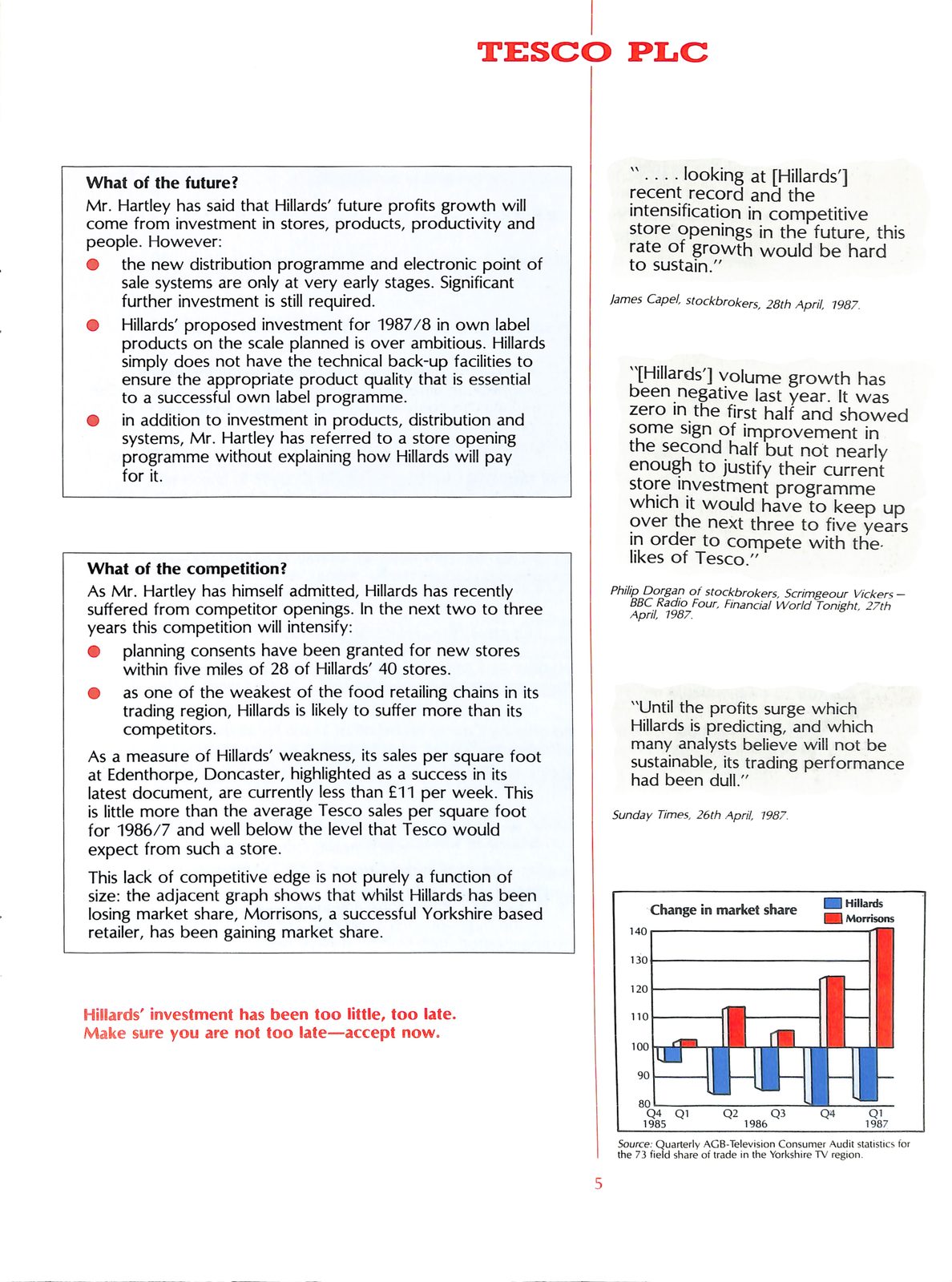
  This lack of competitive edge is not purely a function of
  size: the adjacent graph shows that whilst Hillards has been
  losing  market     share,     Morrisons,             a successful       Yorkshire  based           Change in market share     m    Hillards
                                                                                                                      M o r r i s o n s
  retailer, has     been    gaining           market      share.                                 1 4 0
                                                                                                 1 3 0

                                                                                                 1 2 0
  Hillards'     investment     has    been           too little,    too late.                    1 1 0
  Make        sure     you are     not too               late-accept  now.
                                                                                                 1 0 0


Q 4  Q 1  Q 2  Q 3  Q 4  Q 1
1 9 8 5  1 9 8 6  1 9 8 7
Source:  Quarterly   ACB-Teievision  Consumer  Audit statistics lor
the  73 field share  of trade in the  Yorkshire TV region.

5
TESCOPLC " . . . . looking at [Hillards'] Whatofthefuture ? recent record and the Mr. Hartley has said that Hillards' future profits growth will intensification in competitive come from investment in stores, products, productivity and store openings in the future, this people. However: rate of growth would be hard • the new distribution programme and electronic point of tosustain . " sale systems are only at very early stages. Significant further investment is still required. lames Capei stockbrokers, 28th April,1987. • Hillards' proposed investment for 1987/8 in own label products on the scale planned is over ambitious. Hillards simply does not have the technical back-up facilities to ensure the appropriate product quality that is essential [Hillards'] volume growth has to a successful own label programme. been negative last year. It was • zero in the first half and showed in addition to investment in products, distribution and some sign of improvement in systems, Mr. Hartley has referred to a store opening the second half but not nearly programme without explaining how Hillards will pay enough to justify their current for it. store investment programme which it would have to keep up over the next three to five years in order to compete with the What of the competition? likes of Tesco." As Mr. Hartley has himself admitted, Hillards has recently Philip Dorgan of stockbrokers, Scrimgeour Vickers - suffered from competitor openings. In the next two to three 8BC Radio Four, Financial World Tonight. 27th years this competition will intensify: April,1987. • planning consents have been granted for new stores within five miles of 28 of Hillards' 40 stores. • as one of the weakest of the food retailing chains in its trading region, Hillards is likely to suffer more than its "Until the profits surge which competitors. Hillards is predicting, and which As a measure of Hillards' weakness, its sales per square foot many analysts believe will not be at Edenthorpe, Doncaster, highlighted as a success in its sustainable, its trading performance latest document, are currently less than£11 per week. This hadbeendull . " is little more than the average Tesco sales per square foot Sunday Times, 26th .April,1987. for 1986/7 and well below the level that Tesco would expect from such a store. This lack of competitive edge is not purely a function of size: the adjacent graph shows that whilst Hillards has been losing market share, Morrisons, a successful Yorkshire based Change in market share m Hillards Morrisons retailer, has been gaining market share.140 130 120 Hillards' investment has been too little, too late.110 Make sure you are not too late-accept now. 100 Q4Q1Q2Q3Q4Q1 198519861987 Source: Quarterly ACB-Teievision Consumer Audit statistics lor the 73 field share of trade in the Yorkshire TV region. 5
Read by machine
  TESCO PLC


  What      of the    future?                                                   “.... looking           at    [Hillards’]
                                                                                recent record           and the
  Mr.   Hartley has said that    Hillards’   future profits growth will         intensification         in
  come      from investment in   stores,    products,    productivity and       store                      competitive
                                                                                     Openings             in   the future, this
  people.      However:                                                         rate   of                growth would be hard
  @     the    new    distribution programme     and electronic point of        to sustain.”
        sale   systems  are     only at very early   stages. Significant
        further investment is still     required.                               James Capel, stockbrokers, 28th April, 1987.
                   proposed investment for 1987/8 in     own   label
        products     on the scale planned       is  over ambitious. Hillards
        simply does     not     have the technical back-up facilities   to
        ensure     the appropriate product quality that is essential            “[Hillards’]     volume            growth has
        to   a   successful     own  label programme.                           been     negative         last  year.  It was
  @         addition   to  investment in products, distribution and             zero In     the first      half  and showed
                   Mr.                                                          some sign     of        improvement     in
        systems,     Hartley has referred       to   a   store opening          the    second       half   but not
        programme     without     explaining how Hillards will     pay          enough     to               nearly
        for    it.                                                                                  justify their     current
                                                                                store    Investment         programme
                                                                                which     it     would have     to     keep      up
                                                                                over     the     next   three    to    five years
                                                                                in     order     to compete     with the.
  What of the competition?                                                      likes    of Tesco.”
  As Mr. Hartley has himself admitted, Hillards has recently                    Philip Dorgan of stockbrokers, Scrimgeour Vickers —
  suffered from competitor openings. In the     next two to     three           BBC Radio Four,     Financial World Tonight, 27th
  years     this     competition will intensify:                                April, 1987.
  @     planning     consents    have been granted for     new stores
        within five miles of 28 of Hillards’     40     stores.
  @     as   one     of the weakest of the food retailing chains in     its
        trading region,     Hillards is    likely   to suffer more than its      “Until the     profits    surge which
        competitors.                                                             Hillards is     predicting,    and which
  As  a  measure     of Hillards’    weakness, its sales     per square foot     many    analysts believe will     not     be
  at Edenthorpe, Doncaster, highlighted         as     a success   in  its       sustainable,       its         trading performance
  latest    document,     are    currently  less  than £11    per week. This     had been dull.”
  is little more     than the    average    Tesco sales  per square    foot     Sunday Times, 26th April,  1987.
  for   1986/7 and well     below the level that Tesco would
  expect     from such    a     store.
  This  lack     of competitive edge is     not     purely a  function of
  size:  the adjacent graph shows that whilst Hillards has been                                             Hillards
  losing    market    share, Morrisons,     a successful Yorkshire     based         Change 8    in market share     1H Morrisons
  retailer,    has been gaining market share.                                   140

                                                                                130

                                                                                120

   Hillards’   investment has been     too      little, too late.                110
  Make      sure you are    not too late—accept     now.


  90

  80
 Q4                                                                              Qi Q2                  Q3 Q4 Ql
1985                                                                                                1986     1987
  Source: Quarterly AGB-Television Consumer Audit                                                         statistics     for
  the 73 field share of trade                                                                       in  the Yorkshire TV region.
TESCO PLC What of the future?".... looking at [Hillards'] recent record and the Mr. Hartley has said that Hillards' future profits growth will intensification in come from investment in stores, products, productivity and store competitive Openings in the future, this people. However: rate of growth would be hard @ the new distribution programme and electronic point of to sustain." sale systems are only at very early stages. Significant further investment is still required. James Capel, stockbrokers, 28th April,1987. proposed investment for 1987/8 in own label products on the scale planned is over ambitious. Hillards simply does not have the technical back-up facilities to ensure the appropriate product quality that is essential "[Hillards'] volume growth has to a successful own label programme. been negative last year. It was @ addition to investment in products, distribution and zero In the first half and showed Mr. some sign of improvement in systems, Hartley has referred to a store opening the second half but not programme without explaining how Hillards will pay enough to nearly for it. justify their current store Investment programme which it would have to keep up over the next three to five years in order to compete with the. What of the competition? likes of Tesco." As Mr. Hartley has himself admitted, Hillards has recently Philip Dorgan of stockbrokers, Scrimgeour Vickers - suffered from competitor openings. In the next two to three BBC Radio Four, Financial World Tonight, 27th years this competition will intensify: April,1987. @ planning consents have been granted for new stores within five miles of 28 of Hillards' 40 stores. @ as one of the weakest of the food retailing chains in its trading region, Hillards is likely to suffer more than its "Until the profits surge which competitors. Hillards is predicting, and which As a measure of Hillards' weakness, its sales per square foot many analysts believe will not be at Edenthorpe, Doncaster, highlighted as a success in its sustainable, its trading performance latest document, are currently less than£11 per week. This had been dull." is little more than the average Tesco sales per square foot Sunday Times, 26th April,1987. for 1986/7 and well below the level that Tesco would expect from such a store. This lack of competitive edge is not purely a function of size: the adjacent graph shows that whilst Hillards has been Hillards losing market share, Morrisons, a successful Yorkshire based Change 8 in market share 1H Morrisons retailer, has been gaining market share.140 130 120 Hillards' investment has been too little, too late.110 Make sure you are not too late-accept now. 90 80 Q4 Qi Q2 Q3 Q4 Ql 1985 1986 1987 Source: Quarterly AGB-Television Consumer Audit statistics for the 73 field share of trade in the Yorkshire TV region.
Read by machine, contrast corrected highest quality of the three
  TESCO PLC


  What       of the    future?                                                   “.... looking                  at [Hillards’]
                                                                                 recent record                  and the
  Mr.   Hartley has said that     Hillards’    future profits growth will        intensification                in
  come       from investment in   stores,    products,     productivity and      store                             competitive
                                                                                      Openings                  in the future,     this
  people.       However:                                                         rate   of                          growth would be hard
  @       the   new    distribution programme     and electronic point of        to sustain.”
          sale  systems   are     only at very early   stages. Significant
          further investment is still     required.                              James Capel, stockbrokers,        28th April,   1987.
  @  =    Hillards’    proposed investment for 1987/8 in     own label
          products     on the scale planned      is  over  ambitious. Hillards
          simply does     not     have the technical back-up facilities   to
          ensure     the appropriate product quality that is essential           “[Hillards’]    volume                       growth has
          to  a   successful     own   label programme.                          been     negative              last   year.     It  was
  @  _    in addition    to investment in products, distribution and             zero In     the first            half  and showed
                    Mr.                                                          some sign     of        improvement     in
          systems,     Hartley has referred      to    a   store opening         the    second       half   but not
          programme     without     explaining how Hillards will     pay         enough     to                      nearly
          for   it.                                                                                  justify their               current
                                                                                 store    Investment               programme
                                                                                 which     it  would have           to     keep           up
                                                                                 over     the  next          three     to     five     years
                                                                                 in     order  to    compete        with the.
  What of the competition?                                                       likes    of Tesco.”
  As Mr. Hartley has himself admitted, Hillards has recently                     Philip Dorgan of stockbrokers,     Scrimgeour Vickers     —
  suffered from competitor openings. In the      next two to     three           BBC Radio Four,     Financial     World Tonight, 27th
  years      this     competition will intensify:                                April, 1987.
  @       planning     consents   have been granted for     new  stores
          within five miles of 28 of Hillards’     40    stores.
  @       as  one     of the weakest of the food retailing chains in     its
          trading region,     Hillards is    likely  to suffer more than its      “Until the     profits          surge which
          competitors.                                                            Hillards is     predicting,       and which
  As    a measure     of Hillards’     weakness, its sales     per square foot    many    analysts believe will     not     be
  at    Edenthorpe, Doncaster, highlighted       as     a success   in its        sustainable,       its                 trading performance
  latest     document,     are    currently  less   than £11   per week. This     had been dull.”
  is little  more     than the    average    Tesco sales   per square  foot      Sunday Times, 26th April,        1987.
  for   1986/7 and well     below the level that Tesco would
  expect      from such    a     store.
  This    lack    of competitive edge is     not     purely  a function of
  size:   the adjacent graph shows that whilst Hillards has been                                                    Hillards
  losing     market    share, Morrisons,     a successful Yorkshire    based          Change  8   in market share     IH Morrisons
  retailer,     has been gaining market share.                                   140

                                                                                 130

                                                                                 120

    Hillards’   investment has been     too      little, too late.                110
  Make       sure you are    not too late—accept     now.                         “a
                                                                                      90

                                                                                 80
 Q4                                                                                   Qi             Q2            Q3     Q4         Qi
1985                                                                                                     1986                       1987
                                                                                 Source: Quarterly AGB-Television Consumer Audit statistics for
                                                                                 the 73 field share of trade in the Yorkshire TV region.
TESCO PLC What of the future?".... looking at [Hillards'] recent record and the Mr. Hartley has said that Hillards' future profits growth will intensification in come from investment in stores, products, productivity and store competitive Openings in the future, this people. However: rate of growth would be hard @ the new distribution programme and electronic point of to sustain." sale systems are only at very early stages. Significant further investment is still required. James Capel, stockbrokers, 28th April,1987. @ = Hillards' proposed investment for 1987/8 in own label products on the scale planned is over ambitious. Hillards simply does not have the technical back-up facilities to ensure the appropriate product quality that is essential "[Hillards'] volume growth has to a successful own label programme. been negative last year. It was @ _ in addition to investment in products, distribution and zero In the first half and showed Mr. some sign of improvement in systems, Hartley has referred to a store opening the second half but not programme without explaining how Hillards will pay enough to nearly for it. justify their current store Investment programme which it would have to keep up over the next three to five years in order to compete with the. What of the competition? likes of Tesco." As Mr. Hartley has himself admitted, Hillards has recently Philip Dorgan of stockbrokers, Scrimgeour Vickers - suffered from competitor openings. In the next two to three BBC Radio Four, Financial World Tonight, 27th years this competition will intensify: April,1987. @ planning consents have been granted for new stores within five miles of 28 of Hillards' 40 stores. @ as one of the weakest of the food retailing chains in its trading region, Hillards is likely to suffer more than its "Until the profits surge which competitors. Hillards is predicting, and which As a measure of Hillards' weakness, its sales per square foot many analysts believe will not be at Edenthorpe, Doncaster, highlighted as a success in its sustainable, its trading performance latest document, are currently less than£11 per week. This had been dull." is little more than the average Tesco sales per square foot Sunday Times, 26th April,1987. for 1986/7 and well below the level that Tesco would expect from such a store. This lack of competitive edge is not purely a function of size: the adjacent graph shows that whilst Hillards has been Hillards losing market share, Morrisons, a successful Yorkshire based Change 8 in market share IH Morrisons retailer, has been gaining market share.140 130 120 Hillards' investment has been too little, too late.110 Make sure you are not too late-accept now. "a 90 80 Q4 Qi Q2 Q3 Q4 Qi 1985 1986 1987 Source: Quarterly AGB-Television Consumer Audit statistics for the 73 field share of trade in the Yorkshire TV region.