Hillards Final Result notes 1984/1985 page 2 of 4 previous next
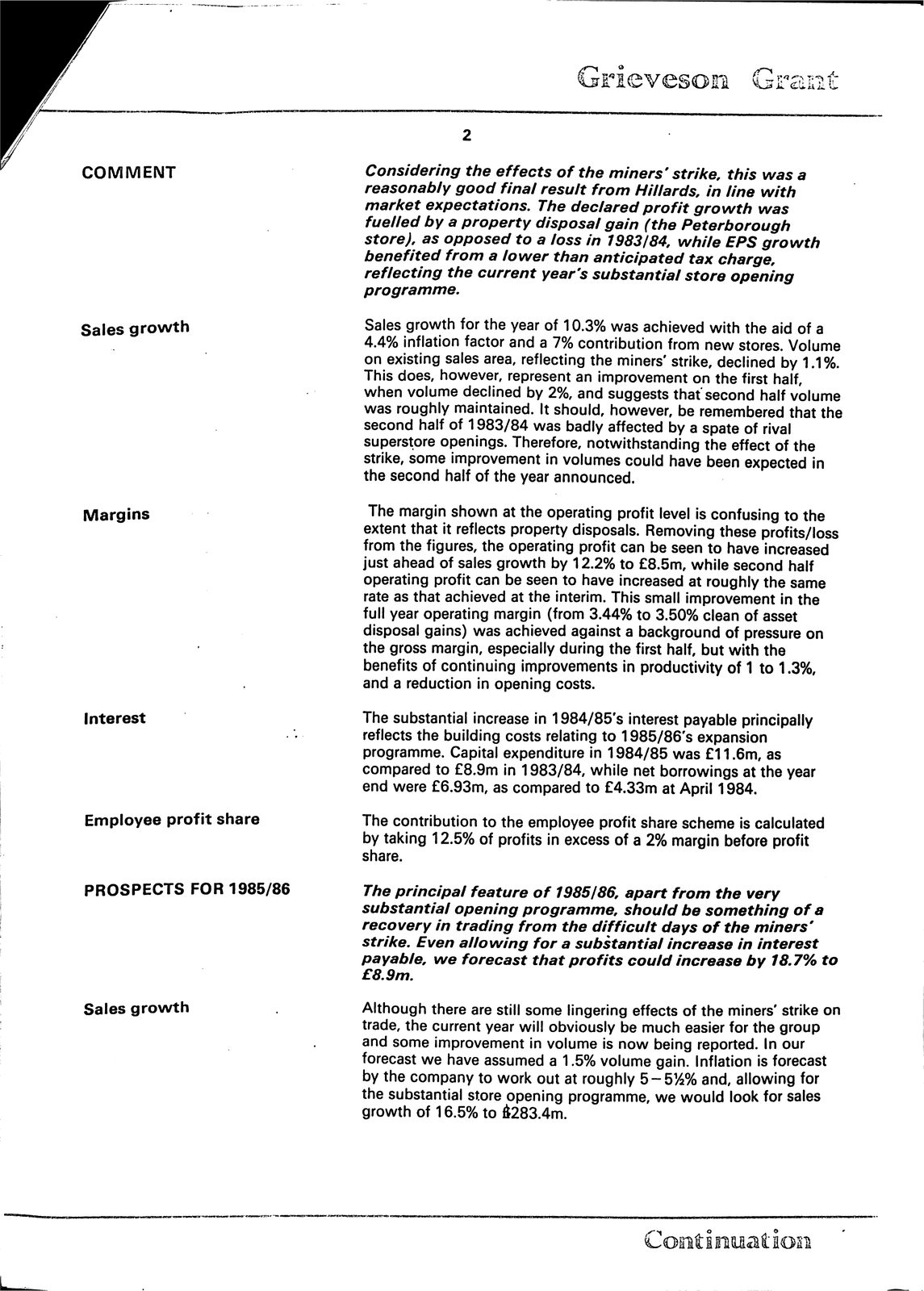
Below is what the machine read from this scan, three times over. They are kept separate rather than merged: where they disagree, the disagreement is itself worth seeing, and a single tidy transcription would hide it.
The left column is raw output. The right is the same text after the repairs that make it searchable — joining letter-spaced words, mending split ones.
Text already in the scan
Grievesoe Graiiit


COMMENT                   Considering the effects of the miners'strike, this was a
                          reasonably good final result from Hillards, in line with
                          market expectations. The declared profit growth was
                          fuelled by a property disposal gain (the Peterborough
                          store), as opposed to a loss in   7983184. while EPS growth
                          benefited from a lower than anticipated tax charge,
                          reflecting the current year's substantial store opening
                          programme.
Sales growth              Sales growth for the year of 10.3% was achieved with the aid of a
                          4.4% inflation factor and a 7% contribution from new stores. Volume
                          on existing sales area, reflecting the miners' strike, declined by 1.1%.
                          This does, however, represent an improvement on the first half,
                          when volume declined by 2%, and suggests that second half volume
                          was roughly maintained. It should, however, be remembered that the
                          second half of 1983/84 was badlyaffected by a spate of rival
                          superstore openings. Therefore, notwithstanding the effect of the
                          strike,     some improvement in volumes could have been expected in
                          the second half of the year announced.
Margins                   The margin shown at the operating profit level isconfusing to the
                          extent that it reflects property disposals.  Removing these profits/loss
                          from the figures, the operating profit can  be seen to have increased
                          just ahead of sales growth by 12.2% to £8.5m, while second half
                          operating profit can be seen to have increased at roughly the same
                          rate as that achieved at the interim. This small improvement in the
                          full year operating margin  (from 3.44% to 3.50% clean of asset
                          disposal gains) was achieved against a background of pressure on
                          the gross margin, especially during the first half, but with the
                          benefits of continuing improvements in productivity of 1 to 1.3%,
                          and a reduction in opening costs.
Interest                  The substantial increase in 1984/85's interest payable principally
                          reflects the building costs relating to 1985/86's expansion
                          programme. Capital expenditure in 1984/85 was £11.6m, as
                          compared to £8.9m in 1983/84, while net borrowings at the year
                          end were £6.93m, as compared to £4.33m at April 1984.
Employee profit share     The contribution to the employee profit share scheme is calculated
                          by taking 12.5%of profits in excess of a 2% margin before profit
                          share.
PROSPECTS FOR 1985/86     The principal feature of 1985186. apart from the very
                          substantial opening programme, should be something of a
                          recovery in trading from the difficult days ofthe miners'
                          strike. Even allowing for a substantial increase in interest
                          payable, we forecast that profits could increase by 18.7% to
                          £8.9m.
Sales growth              Although there are still some lingering effects of the miners' strike on
                          trade, the current year will obviously be much easier for the group
                          and some improvement in volume is now being reported. In our
                          forecast we have assumed a 1.5% volume gain. Inflation isforecast
                          by the company to work out at roughly 5-5%% and, allowing for
                          the substantial store opening programme, we would lookfor sales
                          growth of 16.5% to ft283.4m.
Grievesoe Graiiit COMMENT Considering the effects of the miners'strike, this was a reasonably good final result from Hillards, in line with market expectations. The declared profit growth was fuelled by a property disposal gain (the Peterborough store), as opposed to a loss in 7983184.while EPS growth benefited from a lower than anticipated tax charge, reflecting the current year's substantial store opening programme. Sales growth Sales growth for the year of 10.3% was achieved with the aid of a 4.4%inflation factor and a 7% contribution from new stores. Volume on existing sales area, reflecting the miners' strike, declined by 1.1%. This does, however, represent an improvement on the first half, when volume declined by 2%, and suggests that second half volume was roughly maintained. It should, however, be remembered that the second half of 1983/84 was badlyaffected by a spate of rival superstore openings. Therefore, notwithstanding the effect of the strike, some improvement in volumes could have been expected in the second half of the year announced. Margins The margin shown at the operating profit level isconfusing to the extent that it reflects property disposals. Removing these profits/loss from the figures, the operating profit can be seen to have increased just ahead of sales growth by 12.2% to £8.5m, while second half operating profit can be seen to have increased at roughly the same rate as that achieved at the interim. This small improvement in the full year operating margin (from3.44% to 3.50%clean of asset disposal gains) was achieved against a background of pressure on the gross margin, especially during the first half, but with the benefits of continuing improvements in productivity of 1 to 1.3%, and a reduction in opening costs. Interest The substantial increase in 1984/85's interest payable principally reflects the building costs relating to 1985/86's expansion programme. Capital expenditure in 1984/85 was £11.6m, as compared to £8.9m in 1983/84,while net borrowings at the year end were £6.93m, as compared to £4.33m at April1984. Employee profit share The contribution to the employee profit share scheme is calculated by taking 12.5%of profits in excess of a 2% margin before profit share. PROSPECTS FOR 1985/86 The principal feature of 1985186.apart from the very substantial opening programme, should be something of a recovery in trading from the difficult days ofthe miners' strike. Even allowing for a substantial increase in interest payable, we forecast that profits could increase by 18.7% to £8.9m. Sales growth Although there are still some lingering effects of the miners' strike on trade, the current year will obviously be much easier for the group and some improvement in volume is now being reported. In our forecast we have assumed a 1.5%volume gain. Inflation isforecast by the company to work out at roughly5-5%% and, allowing for the substantial store opening programme, we would lookfor sales growth of 16.5% to ft283.4m.
Read by machine highest quality of the three
aq       a
Grieveson
    <    Grant


                                      2

COMMENT                   Considering the effects         of the miners’     strike,  this  was a
                         reasonably good final        result from Hillards,     in line with
                         market expectations.         The declared       profit growth     was
                         fuelled by   a property      disposal    gain (the Peterborough
                         store),  as  opposed     to  a   loss in 1983/84,     while EPS growth
                         benefited from     a   lower than     anticipated     tax charge,
                         reflecting the     current year’s substantial      store     opening
                         programme.

Sales growth             Sales growth for the   year    of 10.3%  was achieved with the     aid of     a
                         4.4% inflation factor and    a   7% contribution    from     new stores.   Volume
                         on    existing sales area,   reflecting the miners’ strike,     declined by 1.1%.
                         This does, however,       represent  an improvement on     the first half,
                         when volume declined by 2%,          and suggests   that       second half volume
                         was   roughly maintained.    It  should, however, be     remembered      that the
                         second half of 1983/84       was  badly affected by a     spate of rival
                         superstore   openings. Therefore,     notwithstanding     the effect of  the
                         strike, some improvement       in volumes     could have been   expected in
                         the second half of the      year announced.

Margins                   The margin shown       at  the operating    profit level is confusing   to the
    extent that it reflects property disposals. Removing these profits/loss
                          from the figures, the operating    profit   can be seen to  have  increased
                          just ahead of sales growth by 12.2%         to £8.5m, while second half
                         Operating profit   can be    seen to have increased     at   roughly the same
                         rate  as that achieved at    the interim. This   small improvement in     the
                          full year operating margin    (from 3.44%      to  3.50% clean of   asset
                          disposal gains)   was achieved against       a background of   pressure on
                          the  gross  margin, especially during the first    half,  but with the
                         benefits of continuing       improvements in productivity    of 1    to 1.3%,
                          and  a reduction in opening costs.

Interest                  The substantial increase in 1984/85’s interest     payable principally
                          reflects the building costs   relating to           expansion
                          programme.  Capital expenditure in 1984/85       was £11.6m,     as
                          compared    to £8.9m in 1983/84, while         net borrowings  at   the year
                          end   were  £6.93m, as compared     to  £4.33m     at April 1984.

Employee profit share     The contribution    to the employee profit share scheme is calculated
                          by taking 12.5% of  profits in   excess  of    a 2% margin before profit
                          share.

PROSPECTS FOR 1985/86    The principal feature            of 1985/86,  apart from the    very
                          substantial opening              programme,  should be something of     a
                          recovery    in trading from the difficult        days of the miners’
                          strike. Even allowing for       a   substantial    increase in interest
                          payable,    we forecast that     profits could increase by             18.7%  to
                          £8.9m.

Sales growth              Although    there are still some lingering effects of the miners’ strike      on
    trade, the current year will obviously be much easier for the group
    and some improvement in volume is now being reported. In our
    forecast we have assumed a 1.5% volume gain. Inflation is forecast
    by the company to work out at roughly 5—5%% and, allowing for
    the substantial store opening programme, we would look for sales
    growth of 16.5% to #283.4m.


                                                                       Continuation
aq a Grieveson < Grant 2 COMMENT Considering the effects of the miners' strike, this was a reasonably good final result from Hillards, in line with market expectations. The declared profit growth was fuelled by a property disposal gain (the Peterborough store), as opposed to a loss in 1983/84,while EPS growth benefited from a lower than anticipated tax charge, reflecting the current year's substantial store opening programme. Sales growth Sales growth for the year of 10.3% was achieved with the aid of a 4.4%inflation factor and a 7% contribution from new stores. Volume on existing sales area, reflecting the miners' strike, declined by 1.1%. This does, however, represent an improvement on the first half, when volume declined by 2%, and suggests that second half volume was roughly maintained. It should, however, be remembered that the second half of 1983/84 was badly affected by a spate of rival superstore openings. Therefore, notwithstanding the effect of the strike, some improvement in volumes could have been expected in the second half of the year announced. Margins The margin shown at the operating profit level is confusing to the extent that it reflects property disposals. Removing these profits/loss from the figures, the operating profit can be seen to have increased just ahead of sales growth by 12.2% to £8.5m, while second half Operating profit can be seen to have increased at roughly the same rate as that achieved at the interim. This small improvement in the full year operating margin (from3.44% to 3.50%clean of asset disposal gains) was achieved against a background of pressure on the gross margin, especially during the first half, but with the benefits of continuing improvements in productivity of 1 to 1.3%, and a reduction in opening costs. Interest The substantial increase in 1984/85's interest payable principally reflects the building costs relating to expansion programme. Capital expenditure in 1984/85 was £11.6m, as compared to £8.9m in 1983/84,while net borrowings at the year end were £6.93m, as compared to £4.33m at April1984. Employee profit share The contribution to the employee profit share scheme is calculated by taking12.5% of profits in excess of a 2% margin before profit share. PROSPECTS FOR 1985/86 The principal feature of 1985/86,apart from the very substantial opening programme, should be something of a recovery in trading from the difficult days of the miners' strike. Even allowing for a substantial increase in interest payable, we forecast that profits could increase by 18.7% to £8.9m. Sales growth Although there are still some lingering effects of the miners' strike on trade, the current year will obviously be much easier for the group and some improvement in volume is now being reported. In our forecast we have assumed a 1.5%volume gain. Inflation is forecast by the company to work out at roughly5-5%% and, allowing for the substantial store opening programme, we would look for sales growth of 16.5% to #283.4m. Continuation
Read by machine, contrast corrected
aq       a
Grieveson
    <    Grant


                                      2

COMMENT                   Considering the effects         of the miners’     strike,  this  was a
                         reasonably good final        result from Hillards,     in line with
                         market expectations.         The declared       profit growth     was
                         fuelled by   a property      disposal    gain (the Peterborough
                         store),  as  opposed     to  a   loss in 1983/84,     while EPS growth
                         benefited from     a   lower than     anticipated     tax charge,
                         reflecting the     current year’s substantial      store     opening
                         programme.

Sales growth             Sales growth for the   year    of 10.3%  was achieved with the     aid of     a
                         4.4% inflation factor and    a   7% contribution    from     new stores.   Volume
                         on    existing sales area,   reflecting the miners’ strike,     declined by 1.1%.
                         This does, however,       represent  an improvement on     the first half,
                         when volume declined by 2%,          and suggests   that       second half volume
                         was   roughly maintained.    It  should, however, be     remembered      that the
                         second half of 1983/84       was  badly affected by a     spate of rival
                         superstore   openings. Therefore,     notwithstanding     the effect of  the
                         strike, some improvement       in volumes     could have been   expected in
                         the second half of the      year announced.

Margins                   The margin shown       at  the operating    profit level is confusing   to the
    extent that it reflects property disposals. Removing these profits/loss
                          from the figures, the operating    profit   can be seen to  have  increased
                          just ahead of sales growth by 12.2%         to £8.5m, while second half
                         Operating profit   can be    seen to have increased     at   roughly the same
                         rate  as that achieved at    the interim. This   small improvement in     the
                          full year operating margin    (from 3.44%      to  3.50% clean of   asset
                          disposal gains)   was achieved against       a background of   pressure on
                          the  gross  margin, especially during the first    half,  but with the
                         benefits of continuing       improvements in productivity    of 1    to 1.3%,
                          and  a reduction in opening costs.

Interest                  The substantial increase in 1984/85’s interest     payable principally
                          reflects the building costs   relating to           expansion
                          programme.  Capital expenditure in 1984/85       was £11.6m,     as
                          compared    to £8.9m in 1983/84, while         net borrowings  at   the year
                          end   were  £6.93m, as compared     to  £4.33m     at April 1984.

Employee profit share     The contribution    to the employee profit share scheme is calculated
                          by taking 12.5% of  profits in   excess  of    a 2% margin before profit
                          share.

PROSPECTS FOR 1985/86    The principal feature            of 1985/86,  apart from the    very
                          substantial opening              programme,  should be something of     a
                          recovery    in trading from the difficult        days of the miners’
                          strike. Even allowing for       a   substantial    increase in interest
                          payable,    we forecast that     profits could increase by             18.7%  to
                          £8.9m.

Sales growth              Although    there are still some lingering effects of the miners’ strike      on
    trade, the current year will obviously be much easier for the group
    and some improvement in volume is now being reported. In our
    forecast we have assumed a 1.5% volume gain. Inflation is forecast
    by the company to work out at roughly 5—5%% and, allowing for
    the substantial store opening programme, we would look for sales
    growth of 16.5% to #283.4m.


                                                                       Continuation
aq a Grieveson < Grant 2 COMMENT Considering the effects of the miners' strike, this was a reasonably good final result from Hillards, in line with market expectations. The declared profit growth was fuelled by a property disposal gain (the Peterborough store), as opposed to a loss in 1983/84,while EPS growth benefited from a lower than anticipated tax charge, reflecting the current year's substantial store opening programme. Sales growth Sales growth for the year of 10.3% was achieved with the aid of a 4.4%inflation factor and a 7% contribution from new stores. Volume on existing sales area, reflecting the miners' strike, declined by 1.1%. This does, however, represent an improvement on the first half, when volume declined by 2%, and suggests that second half volume was roughly maintained. It should, however, be remembered that the second half of 1983/84 was badly affected by a spate of rival superstore openings. Therefore, notwithstanding the effect of the strike, some improvement in volumes could have been expected in the second half of the year announced. Margins The margin shown at the operating profit level is confusing to the extent that it reflects property disposals. Removing these profits/loss from the figures, the operating profit can be seen to have increased just ahead of sales growth by 12.2% to £8.5m, while second half Operating profit can be seen to have increased at roughly the same rate as that achieved at the interim. This small improvement in the full year operating margin (from3.44% to 3.50%clean of asset disposal gains) was achieved against a background of pressure on the gross margin, especially during the first half, but with the benefits of continuing improvements in productivity of 1 to 1.3%, and a reduction in opening costs. Interest The substantial increase in 1984/85's interest payable principally reflects the building costs relating to expansion programme. Capital expenditure in 1984/85 was £11.6m, as compared to £8.9m in 1983/84,while net borrowings at the year end were £6.93m, as compared to £4.33m at April1984. Employee profit share The contribution to the employee profit share scheme is calculated by taking12.5% of profits in excess of a 2% margin before profit share. PROSPECTS FOR 1985/86 The principal feature of 1985/86,apart from the very substantial opening programme, should be something of a recovery in trading from the difficult days of the miners' strike. Even allowing for a substantial increase in interest payable, we forecast that profits could increase by 18.7% to £8.9m. Sales growth Although there are still some lingering effects of the miners' strike on trade, the current year will obviously be much easier for the group and some improvement in volume is now being reported. In our forecast we have assumed a 1.5%volume gain. Inflation is forecast by the company to work out at roughly5-5%% and, allowing for the substantial store opening programme, we would look for sales growth of 16.5% to #283.4m. Continuation