Hillards News March 1984 Issue Number 4 page 7 of 12 previous next
Below is what the machine read from this scan, three times over. They are kept separate rather than merged: where they disagree, the disagreement is itself worth seeing, and a single tidy transcription would hide it.
The left column is raw output. The right is the same text after the repairs that make it searchable — joining letter-spaced words, mending split ones.
Text already in the scan
         DECISIOH                                                                                                   TIME
         APPBOACHES
         The     last issue     of     Hillards     News     announced     the                               start      of     two      employee                       share
         schemes,     subject     of     course     to     shareholders'                                 approval
                                                                                                                        .
         That approval was given unanimously at an Extraordinary General Meeting held in September.
         Since then you've had the opportunity to read the 'book', see the 'film' and asked lots of
         questions. Now decision time approaches.
                                                                                                                  CASH                               OR
                                                                                                                    SHARES

                                                                                                         Looking at the Employee Profit Share Scheme
                                                                                                         first, all       you have to do is          decide whether             to
                                                                                                         take your slice of profits in cash or to become
                                                                                                         shareholders     in        your     company.
                                                                                                         The advantage             of    cash    payment is               obvious,
                                                                                                         it's          money in your     pocket      to   spend or            save
                                                                                                         as you wish.
                                                                                                         But you will              have almost        certainly     to         pay
                                                                                                         income  tax          on   it  and           perhaps  an        additional
                                                                                                         n a t i o n a l i n s u r a n c e c o n t r r b u T r o n .
                                                                                                         And getting             down to 'brass       tacks'          that   could
                                                                                                         mean         almost    £40    stoppages      on      a     £100    proFtt
                                                                                                         s h a r e .
                                                                                                         The alternative          is     to  take            payment in   Hillards
                                                                                                         Ordinary                 Shares-to  become                  shareholders.
                                                                                                         The    only     condition       is  shares   must     be left        with
                                                                                                         trustees       for   a two-year           retention period         before
                                                                                                         you    can     sell    them.
                                                                                                         Taking     shares        means      you      get full    value        for
                                                                                                         your     money        and pay     no    tax  immediately     -        and
                                                                                                         possibly       none    at all if    you  hold    the     shares      long
NEST EGG FOR     THE     FUTURE                                                                          enough.
                                                                                                         Tax is payable on shares sold up to four years
                                                                                                         after        allocation    assessed      on      the       price     when
Shares will also earn you money - a dividend - and can increase in market value. Remember though that    they     were     first    allocated     to      you.
the companv cannot guarantee share prices and that external factors can influence their rise and fall.   After    four       years  the   tax        payable       reduces   until
                                                                                                         you reach a tax-free level after                             a seven year
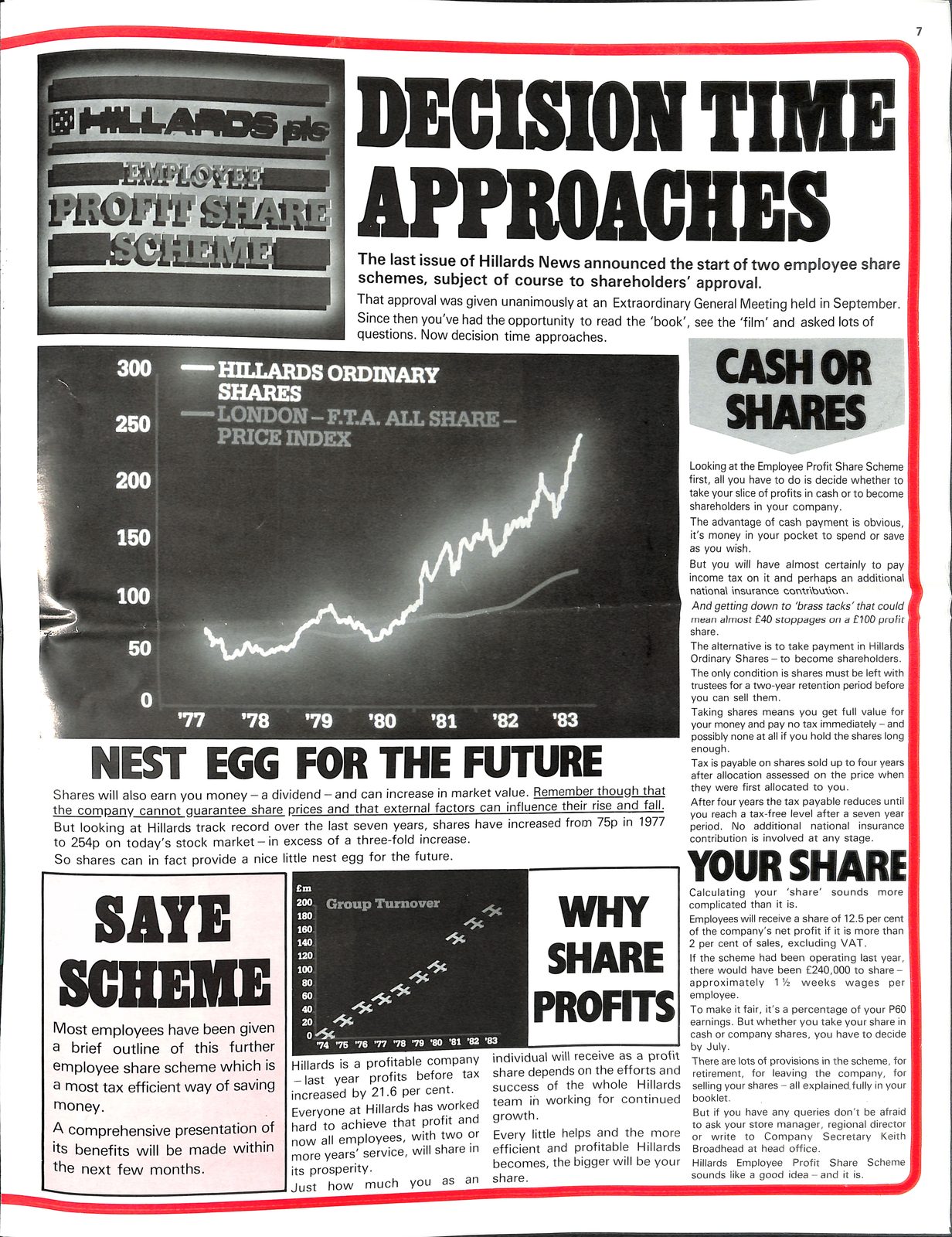
But looking at Hillards track record over the last seven years, shares have increased from 75p in 1977   period.          No       additional    national                insurance
to 254p on today's stock market-in excess of a three-fold increase.                                      contribution     is      involved       at      any    stage.
So shares can in fact provide a nice little nest egg for the future.                                     YOUR                                                SHARE
                                                                                                         C a l c u l a t i n g  y o u r     ' s h a r e ' s o u n d s      m o r e
SATE     G r o u p  Tu r n o v e r        W H Y                                                          complicated     than      it     is.
                                                                                                         Employees will receive a share of 12.5 per cent
                                                                                                         of   the   company's          net   profit  if   it      is  more    than
                                                                   SHARE                                 2    per   cent     of  sales,            excluding    VAT.
                                                                                                         If   the   scheme        had     been    operating           last   year,
                                                                                                         there         would    have     been               £240,000  to    share-
DECISIOH TIME APPBOACHES The last issue of Hillards News announced the start of two employee share schemes, subject of course to shareholders' approval . That approval was given unanimously at an Extraordinary General Meeting held in September. Since then you've had the opportunity to read the 'book', see the 'film' and asked lots of questions. Now decision time approaches. CASH OR SHARES Looking at the Employee Profit Share Scheme first, all you have to do is decide whether to take your slice of profits in cash or to become shareholders in your company. The advantage of cash payment is obvious, it's money in your pocket to spend or save as you wish. But you will have almost certainly to pay income tax on it and perhaps an additional nationalinsurancecontrrbuTron . And getting down to 'brass tacks' that could mean almost£40 stoppages on a £100 proFtt share . The alternative is to take payment in Hillards Ordinary Shares-to become shareholders. The only condition is shares must be left with trustees for a two-year retention period before you can sell them. Taking shares means you get full value for your money and pay no tax immediately - and possibly none at all if you hold the shares long NEST EGG FOR THE FUTURE enough. Tax is payable on shares sold up to four years after allocation assessed on the price when Shares will also earn you money - a dividend - and can increase in market value. Remember though that they were first allocated to you. the companv cannot guarantee share prices and that external factors can influence their rise and fall. After four years the tax payable reduces until you reach a tax-free level after a seven year But looking at Hillards track record over the last seven years, shares have increased from 75p in 1977period. No additional national insurance to 254p on today's stock market-in excess of a three-fold increase. contribution is involved at any stage. So shares can in fact provide a nice little nest egg for the future. YOUR SHARE Calculatingyour ' share ' soundsmore SATE Group Tu rnoverWHY complicated than it is. Employees will receive a share of 12.5percent of the company's net profit if it is more than SHARE 2 per cent of sales, excluding VAT. If the scheme had been operating last year, there would have been£240,000 to share-
Read by machine highest quality of the three
i
DECISION TIME
APPROACHES i
The last issue of Hillards News announced the start of two employee
schemes, subject of course to shareholders’ approval.
That approval was given unanimously at an Extraordinary General Meeting held in September. |
Since then you've had the opportunity to read the ‘book’, see the ‘film’ and asked lots of
questions. Now decision time approaches.
Looking at the Employee Profit Share Scheme |
first, all you have to do is decide whether
|
take your slice of profits in cash or to become
shareholders in your company.
The advantage of cash payment is obvious, jm
it's money in your pocket to spend or save
as you wish.
But you will have almost certainly to pay
income tax on it and perhaps an additional
national insurance contribution.
And getting down to ‘brass tacks’ that could |
mean almost £40 stoppages on a £700 profit
share. i |
The alternative is to take payment in Hillards
— to become shareholders. |
Ordinary Shares
The only condition is shares must be left with |
trustees for a two-year retention period before |
tl
you can sell them.
Taking shares means you get full value for
your money and pay no tax immediately — and
possibly none at all if you hold the shares long |
enough.
T EGG FOR T Fee E Tax is payable on shares sold up to four years
after allocation assessed on the price when
Shares will also earn you money — a dividend — and can increase in market value. Remember though that they were first allocated to you. |
influenc their and fall. After four years the tax paya ble reduces until
the company cannot guarantee share prices. and that external factors can - nce rise vou 9 level after a sagan
But looking at Hillards track record over the last seven years, shares have increased from 75p in 1977 period. No additional national insurance (im
to 254p on today’s stock excess of a three-fold increase. contribution is involved at any stage.
£m Calculating your ‘share’ sounds more
200 complicated than it is.
Employees will receive a share of 12.5 per cent
160 of the company’s net profit if it is more than |
140 2 per cent of sales, excluding VAT. |
120 If the scheme had been operating last year,
100 there would have been £240,000 to share—
80 approximately 1% weeks wages per
60 employee.
40 To make it fair, it's a percentage of your P60 |
Most employees have been given 20 | earnings. But whether you take your share in |
0M company shares, to
have
‘78 ‘79 "80 eT cash or you decide
a brief outline of this further 74 "76 '77 SS individual will receive as a profit by July.
share scheme which is | Hillards is a profitable company share depends the efforts and There are lots of provisions in the scheme, for
of : —last year profits before tax on for leaving the company, for
a most tax efficient of the whole Hillards — all explained fully
way saving success selling your shares in your
by 21.6 per cent. ir workingi for continued booklet.
aE Everyone at has worked growth. boo 1 ave any don’ be aaa i
A presentation of | hard to achieve that pro to ask your store manager, regional director
comprehensive with Every little helps and the more
j now all employees, t two or or write to Company Secretary Keith |
its benefits will be made within years’ service, will share efficient and profitable Hillards Broadhead at head office. 5
more bigg will be y your HillardsHi Employee Profiti Share Scheme
the next few months. its prosperity. . becomes, the bigger sounds like a
Just how much you as an share. 3 good idea — and it is.i DECISION TIME APPROACHES i The last issue of Hillards News announced the start of two employee schemes, subject of course to shareholders' approval. That approval was given unanimously at an Extraordinary General Meeting held in September. | Since then you've had the opportunity to read the 'book', see the 'film' and asked lots of questions. Now decision time approaches. Looking at the Employee Profit Share Scheme | first, all you have to do is decide whether | take your slice of profits in cash or to become shareholders in your company. The advantage of cash payment is obvious, jm it's money in your pocket to spend or save as you wish. But you will have almost certainly to pay income tax on it and perhaps an additional national insurance contribution. And getting down to 'brass tacks' that could | mean almost£40 stoppages on a £700profit share. i | The alternative is to take payment in Hillards - to become shareholders. | Ordinary Shares The only condition is shares must be left with | trustees for a two-year retention period before | tl you can sell them. Taking shares means you get full value for your money and pay no tax immediately - and possibly none at all if you hold the shares long | enough. T EGG FOR T Fee E Tax is payable on shares sold up to four years after allocation assessed on the price when Shares will also earn you money - a dividend - and can increase in market value. Remember though that they were first allocated to you. | influenc their and fall. After four years the tax payable reduces until the company cannot guarantee share prices. and that external factors can - nce rise vou 9 level after a sagan But looking at Hillards track record over the last seven years, shares have increased from 75p in 1977period. No additional national insurance (im to 254p on today's stock excess of a three-fold increase. contribution is involved at any stage. £m Calculating your 'share' sounds more 200complicated than it is. Employees will receive a share of 12.5percent 160 of the company's net profit if it is more than | 140 2 per cent of sales, excluding VAT. | 120 If the scheme had been operating last year, 100there would have been£240,000 to share- 80 approximately 1% weeks wages per 60 employee. 40 To make it fair, it's a percentage of your P60 | Most employees have been given 20 | earnings. But whether you take your share in | 0M company shares, to have '78 '79 "80 eT cash or you decide a brief outline of this further74"76 '77 SS individual will receive as a profit by July. share scheme which is | Hillards is a profitable company share depends the efforts and There are lots of provisions in the scheme, for of : -last year profits before tax on for leaving the company, for a most tax efficient of the whole Hillards - all explained fully way saving success selling your shares in your by 21.6percent. ir workingi for continued booklet. aE Everyone at has worked growth. boo 1 ave any don' be aaa i A presentation of | hard to achieve that pro to ask your store manager, regional director comprehensive with Every little helps and the more j now all employees, t two or or write to Company Secretary Keith | its benefits will be made within years' service, will share efficient and profitable Hillards Broadhead at head office. 5 more bigg will be y your HillardsHi Employee Profiti Share Scheme the next few months. its prosperity. . becomes, the bigger sounds like a Just how much you as an share. 3 good idea - and it is.
Read by machine, contrast corrected
j
DECISION TIME
APPROACHES j
The last issue of Hillards News announced the start of two employee
schemes, subject of course to shareholders’ approval.
That approval was given unanimously at an Extraordinary General Meeting held in September. |
Since then you've had the opportunity to read the ‘book’, see the ‘film’ and asked lots of
questions. Now decision time approaches.
SHARES
Looking at the Employee Profit Share Scheme
first, all you have to do is decide whether to
|
take your slice of profits in cash or to become
shareholders in your company.
The advantage of cash payment is obvious, |
it’s money in your pocket to spend or save
as you wish.
But you will have almost certainly to pay
income tax on it and perhaps an additional
national insurance contribution. =
And getting down to ‘brass tacks’ that could |
mean almost £40 stoppages on a £100
share. | |
The alternative is to take payment in Hillards
|
Ordinary Shares—to become shareholders.
The only condition is shares must be left with |
trustees for a two-year retention period before |
you can sell them.
Taking shares means you get full value for |
your money and pay no tax immediately — and
|
possibly none at all if you hold the shares long |
enough.
T EGG FOR T ae E Tax is payable on shares sold up to four years
after allocation assessed on the price when
Shares will also earn you money — a dividend — and can increase in market value. Remember though that they were first allocated to you.
the guarantee share prices. and that external factors can influenc e their rise and fall. After four years the tax payable reduces until
But company cannot have increased from 75p in 1977 you a level after a Seven your |
looking at Hillards track record over the last seven years, shares period. No additional national insurance [il
to 254p on today’s stock excess of a three-fold increase. contribution is involved at any stage.
a Calculating your ‘share’ sounds more
200. | oup Tur! rer A complicated than it is.
Employees will receive a share of 12.5 per cent |
160 of the company’s net profit if it is more than | |
140 2 per cent of sales, excluding VAT. |
120 If the scheme had been operating last year,
100 there would have been £240,000 to share—
80 approximately 1% weeks wages per
60 employee.
40 To make it fair, it's a percentage of your P60
Most employees have been given 20 Fe: | earnings. But whether you take your share in |
0 h or company shares ide
a brief outline of this further "74°75 "76 "77 '78 '79 ‘80 ‘81 ‘82 individual will. profit a by July. pany , you have to decid
employee share scheme which is Hillards is a profitable company the e orts and There are lots of provisions in the scheme, for
of —last year profits before tax share depends on retirement, for leaving the company, for
a most tax efficient saving of the whole Hillards — all explained fully your
way increased by 21.6 per cent. success selling your shares in
money. Everyon e at Hillards has worked team in working for continued booklet.
A presentation of hard to achieve. that profiti and 9 rowth. But if you have any queries don’t be afraid |
comprehensive with Every little helps and the more to ask your store manager, regional director [im
its benefits will be made within now all employees, two or and profitable Hillards or write to Company Secretary Keith
more years’ service, will share in efficient will Broadhead at head office. |
the next few months. its prosperity. becomes, the bigger your Hillards Scheme be Employee Profit Share
Just how much you as an share. 3j DECISION TIME APPROACHES j The last issue of Hillards News announced the start of two employee schemes, subject of course to shareholders' approval. That approval was given unanimously at an Extraordinary General Meeting held in September. | Since then you've had the opportunity to read the 'book', see the 'film' and asked lots of questions. Now decision time approaches. SHARES Looking at the Employee Profit Share Scheme first, all you have to do is decide whether to | take your slice of profits in cash or to become shareholders in your company. The advantage of cash payment is obvious, | it's money in your pocket to spend or save as you wish. But you will have almost certainly to pay income tax on it and perhaps an additional national insurance contribution. = And getting down to 'brass tacks' that could | mean almost£40 stoppages on a £100 share. | | The alternative is to take payment in Hillards | Ordinary Shares-to become shareholders. The only condition is shares must be left with | trustees for a two-year retention period before | you can sell them. Taking shares means you get full value for | your money and pay no tax immediately - and | possibly none at all if you hold the shares long | enough. T EGG FOR T ae E Tax is payable on shares sold up to four years after allocation assessed on the price when Shares will also earn you money - a dividend - and can increase in market value. Remember though that they were first allocated to you. the guarantee share prices. and that external factors can influence their rise and fall. After four years the tax payable reduces until But company cannot have increased from 75p in 1977 you a level after a Seven your | looking at Hillards track record over the last seven years, shares period. No additional national insurance [il to 254p on today's stock excess of a three-fold increase. contribution is involved at any stage. a Calculating your 'share' sounds more 200. | oup Tur! rer A complicated than it is. Employees will receive a share of 12.5percent | 160 of the company's net profit if it is more than | | 140 2 per cent of sales, excluding VAT. | 120 If the scheme had been operating last year, 100there would have been£240,000 to share- 80 approximately 1% weeks wages per 60 employee. 40 To make it fair, it's a percentage of your P60 Most employees have been given 20 Fe: | earnings. But whether you take your share in | 0 h or company shares ide a brief outline of this further"74°75"76 "77 '78 '79 '80 '81'82individual will. profit a by July. pany , you have to decid employee share scheme which is Hillards is a profitable company the e orts and There are lots of provisions in the scheme, for of -last year profits before tax share depends on retirement, for leaving the company, for a most tax efficient saving of the whole Hillards - all explained fully your way increased by 21.6percent. success selling your shares in money. Everyone at Hillards has worked team in working for continued booklet. A presentation of hard to achieve. that profiti and 9 rowth. But if you have any queries don't be afraid | comprehensive with Every little helps and the more to ask your store manager, regional director [im its benefits will be made within now all employees, two or and profitable Hillards or write to Company Secretary Keith more years' service, will share in efficient will Broadhead at head office. | the next few months. its prosperity. becomes, the bigger your Hillards Scheme be Employee Profit Share Just how much you as an share. 3