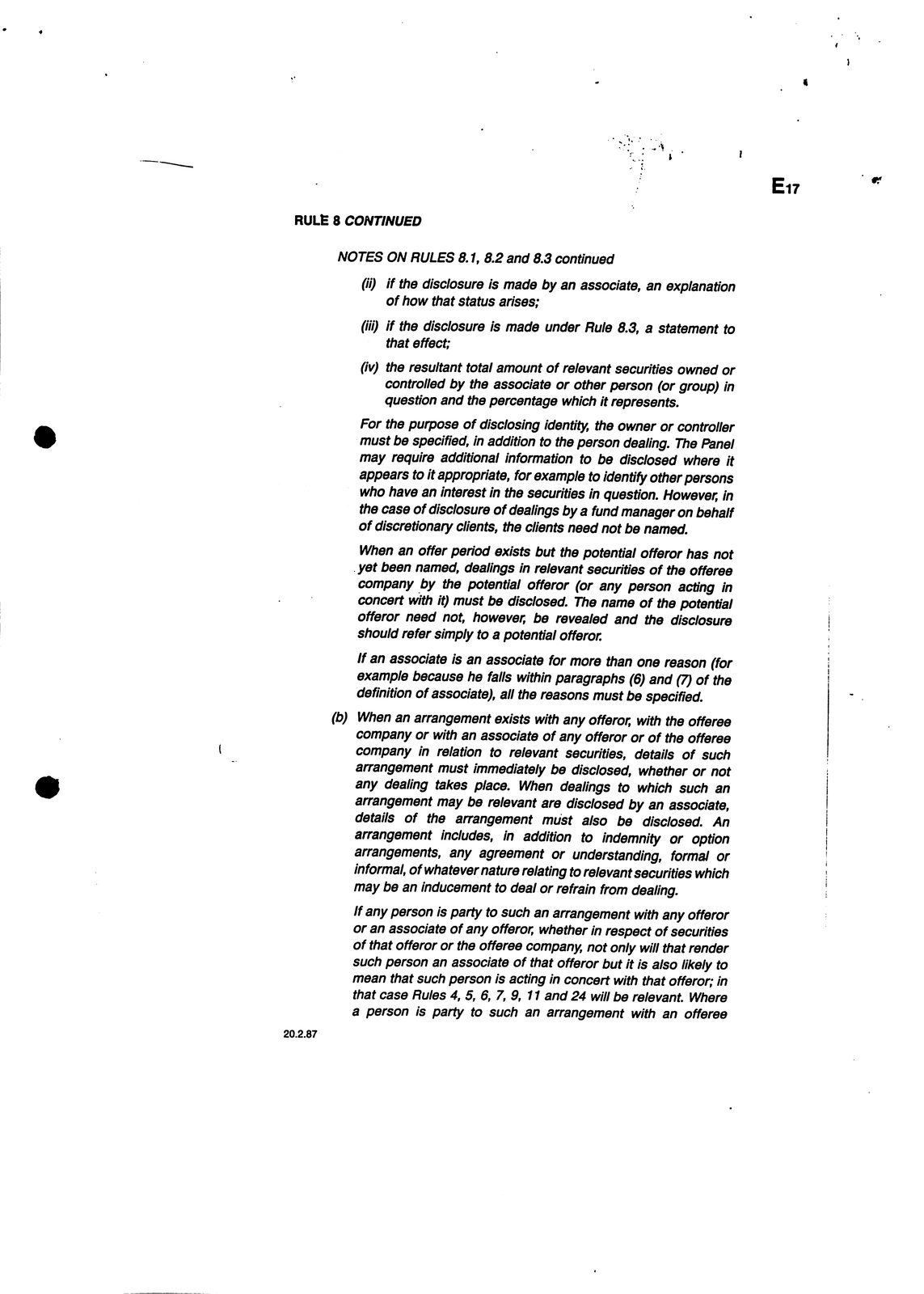
Below is what the machine read from this scan, three times over. They are kept separate rather than merged: where they disagree, the disagreement is itself worth seeing, and a single tidy transcription would hide it.
The left column is raw output. The right is the same text after the repairs that make it searchable — joining letter-spaced words, mending split ones.
Text already in the scan
                                            I

                                            Ei7

RULE  8 CONTINUED

      NOTES ON RULES 8.1, 8.2 and 8.3       continued
           (ii) if the disclosure is made by an associate, an explanation
                  of  how that     status  arises;
           (Hi)   if          the disclosure is made under Rule 8.3, a statement to
                  that  effect;
           (iv)   the   resultant   total  amount   of relevant securities owned or
                         controlled by the associate or other person (or group) in
                  question and the percentage which it represents.
           For the purpose of disclosing Identity, the owner or controller
           must be specified, in addition to the person dealing. The Panel
           may require additional information to be disclosed where it
           appears to it appropriate, for example to identify other persons
           who have an interest in the securities in question. However, in
           the case of disclosure of dealings by a fund manager on behalf
           of discretionary clients, the clients need not be named.
           When an offer period exists but the potential offeror has not
           yet been named, dealings In relevant securities of the offeree
           company by the potential offeror (or any person acting In
           concert with it) must be disclosed. The name of the potential
           offeror    need not,     however, be revealed and the disclosure
           should refer simply to a potential offeror.
           If an associate is an associate for more than one reason (for
           example because he fails within paragraphs (6) and (7) of the
        definition of associate), all the reasons must be specified.
                 (b) When an arrangement exists with any offeror, with the offeree
        company or with an associate of any offeror or of the offeree
        company in        relation        to relevant  securities, details of such
        arrangement must immediately be disclosed, whether or not
        any dealing takes place. When dealings to which such an
        arrangement may be relevant are disclosed by an associate,
        details       of the   arrangement     must    also     be disclosed.   An
        arrangement includes, in addition to indemnity or option
        arrangements, any agreement or understanding, formal or
        informal, of whatever nature relating to relevant securities which
        may be an inducement to deal or refrain from dealing.
        if             any person is party to such an arrangement with any offeror
        or an associate of any offeror, whether in respect of securities
        of that offeror or the offeree company, not only will that render
        such person an associate of that offeror but it is also likely to
        mean that such person is acting in concert with that offeror; in
        that     case   Rules   4,  5,  6,   7,9,11 and 24 wiii be relevant. Where
        a person is          party  to         such an arrangement with an offeree
I Ei7 RULE 8 CONTINUED NOTES ON RULES8.1,8.2 and 8.3continued (ii) if the disclosure is made by an associate, an explanation of how that status arises; (Hi) if the disclosure is made under Rule8.3, a statement to that effect; (iv) the resultant total amount of relevant securities owned or controlled by the associate or other person (or group) in question and the percentage which it represents. For the purpose of disclosing Identity, the owner or controller must be specified, in addition to the person dealing. The Panel may require additional information to be disclosed where it appears to it appropriate, for example to identify other persons who have an interest in the securities in question. However, in the case of disclosure of dealings by a fund manager on behalf of discretionary clients, the clients need not be named. When an offer period exists but the potential offeror has not yet been named, dealings In relevant securities of the offeree company by the potential offeror (or any person acting In concert with it) must be disclosed. The name of the potential offeror need not, however, be revealed and the disclosure should refer simply to a potential offeror. If an associate is an associate for more than one reason (for example because he fails within paragraphs(6) and (7) of the definition of associate), all the reasons must be specified. (b) When an arrangement exists with any offeror, with the offeree company or with an associate of any offeror or of the offeree company in relation to relevant securities, details of such arrangement must immediately be disclosed, whether or not any dealing takes place. When dealings to which such an arrangement may be relevant are disclosed by an associate, details of the arrangement must also be disclosed. An arrangement includes, in addition to indemnity or option arrangements, any agreement or understanding, formal or informal, of whatever nature relating to relevant securities which may be an inducement to deal or refrain from dealing. if any person is party to such an arrangement with any offeror or an associate of any offeror, whether in respect of securities of that offeror or the offeree company, not only will that render such person an associate of that offeror but it is also likely to mean that such person is acting in concert with that offeror; in that case Rules 4, 5, 6, 7,9,11 and 24 wiii be relevant. Where a person is party to such an arrangement with an offeree
Read by machine highest quality of the three
                                                                                  E17

  RULE 8 CONTINUED

      NOTES ON RULES 8.1, 8.2           and 8.3 continued

(ii)               if the disclosure is made by     an   associate,   an   explanation
                   of how that status arises;

           (iii)   if the disclosure is made under     Rule 8.3,      a   statement to
                   that effect;

           (iv)    the resultant total  amount of relevant securities     owned     or
                   controlled by the associate    or   other  person    (or group) in
                   question and the    percentage which it    represents.
           For the   purpose    of disclosing identity,  the       owner or controller
           must be specified, in addition      to the  person    dealing.   The Panel
           may     require additional     information    to be disclosed      where it
           appears     to it appropriate, for example    to identify other    persons
           who have     an interest in  the securities in       question. However, in
           the    case    of disclosure of dealings  by  a  fund manager on     behalf
         of discretionary clients, the     clients need     not be named.
           When     an    offer period exists but    the potential offeror has    not
         .yet been named, dealings in relevant              securities of the offeree
         company       by the potential    offeror     (or  any person     acting  in
         concert     with  it) must be disclosed.     The    name    of the potential
         offeror    need not,    however,   be revealed       and the      disclosure
         should refer simply     to     a potential offeror.
         If an     associate is  an associate for       more than  one reason    (for
         example because he falls       within    paragraphs (6) and (7) of       the
         definition of associate),      all the reasons must be       specified.
  (b)    When            an arrangement exists with  any  offeror,   with the offeree
         company or with     an     associate of     any  offeror  or  of the offeree
         company       in  relation    to  relevant   securities,  details  of   such
         arrangement must immediately be disclosed,               whether      or not
         any     dealing   takes place.   When dealings         to which    such   an
         arrangement     may     be relevant    are  disclosed by     an   associate,
         details    of    the  arrangement     must     also  be    disclosed.     An
         arrangement     includes,      in   addition    to  indemnity    or   option
         arrangements,     any      agreement   or   understanding,       formal   or
         informal, of whatever      nature relating to relevant      securities which
         may     be an       inducement to deal or refrain from    dealing.
         If any person     is party to such an  arrangement with         any  offeror
         or an     associate of  any    offeror, whether in     respect of securities
         of that offeror   or  the offeree         company, not only will that render
         such     person an    associate of that offeror     but it is also likely to
         mean      that such     person is acting in concert with that offeror: in
         that   case   Rules 4, 5,  6,  7, 9, 11 and 24     will be relevant. Where
         a    person   is party  to    such   an arrangement      with   an   offeree
  20.2.87
E17 RULE 8 CONTINUED NOTES ON RULES8.1,8.2 and 8.3continued (ii) if the disclosure is made by an associate, an explanation of how that status arises; (iii) if the disclosure is made under Rule8.3, a statement to that effect; (iv) the resultant total amount of relevant securities owned or controlled by the associate or other person (or group) in question and the percentage which it represents. For the purpose of disclosing identity, the owner or controller must be specified, in addition to the person dealing. The Panel may require additional information to be disclosed where it appears to it appropriate, for example to identify other persons who have an interest in the securities in question. However, in the case of disclosure of dealings by a fund manager on behalf of discretionary clients, the clients need not be named. When an offer period exists but the potential offeror has not .yet been named, dealings in relevant securities of the offeree company by the potential offeror (or any person acting in concert with it) must be disclosed. The name of the potential offeror need not, however, be revealed and the disclosure should refer simply to a potential offeror. If an associate is an associate for more than one reason (for example because he falls within paragraphs(6) and (7) of the definition of associate), all the reasons must be specified. (b) When an arrangement exists with any offeror, with the offeree company or with an associate of any offeror or of the offeree company in relation to relevant securities, details of such arrangement must immediately be disclosed, whether or not any dealing takes place. When dealings to which such an arrangement may be relevant are disclosed by an associate, details of the arrangement must also be disclosed. An arrangement includes, in addition to indemnity or option arrangements, any agreement or understanding, formal or informal, of whatever nature relating to relevant securities which may be an inducement to deal or refrain from dealing. If any person is party to such an arrangement with any offeror or an associate of any offeror, whether in respect of securities of that offeror or the offeree company, not only will that render such person an associate of that offeror but it is also likely to mean that such person is acting in concert with that offeror: in that case Rules 4, 5, 6, 7, 9, 11 and 24 will be relevant. Where a person is party to such an arrangement with an offeree 20.2.87
Read by machine, contrast corrected
                                                                                  E17

  RULE 8 CONTINUED

      NOTES ON RULES 8.1, 8.2           and 8.3 continued

(ii)               if the disclosure is made by     an   associate,   an   explanation
                   of how that status arises;

           (iii)   if the disclosure is made under     Rule 8.3,      a   statement to
                   that effect;

           (iv)    the resultant total  amount of relevant securities     owned     or
                   controlled by the associate    or   other  person    (or group) in
                   question and the    percentage which it    represents.
           For the   purpose    of disclosing identity,  the       owner or controller
           must be specified, in addition      to the  person    dealing.   The Panel
           may     require additional     information    to be disclosed      where it
           appears     to it appropriate, for example    to identify other    persons
           who have     an interest in  the securities in       question. However, in
           the    case    of disclosure of dealings  by  a  fund manager on     behalf
         of discretionary clients, the     clients need     not be named.
           When     an    offer period exists but    the potential offeror has    not
         .yet been named, dealings in relevant              securities of the offeree
         company       by the potential    offeror     (or  any person     acting  in
         concert     with  it) must be disclosed.     The    name    of the potential
         offeror    need not,    however,   be revealed       and the      disclosure
         should refer simply     to     a potential offeror.
         If an     associate is  an associate for       more than  one reason    (for
         example because he falls       within    paragraphs (6) and (7) of       the
         definition of associate),      all the reasons must be       specified.
  (b)    When            an arrangement exists with  any  offeror,   with the offeree
         company or with     an     associate of     any  offeror  or  of the offeree
         company       in  relation    to  relevant   securities,  details  of   such
         arrangement must immediately be disclosed,               whether      or not
         any     dealing   takes place.   When dealings         to which    such   an
         arrangement     may     be relevant    are  disclosed by     an   associate,
         details    of    the  arrangement     must     also  be    disclosed.     An
         arrangement     includes,      in   addition    to  indemnity    or   option
         arrangements,     any      agreement   or   understanding,       formal   or
         informal, of whatever      nature relating to relevant      securities which
         may     be an       inducement to deal or refrain from    dealing.
         If any person     is party to such an  arrangement with         any  offeror
         or an     associate of  any    offeror, whether in     respect of securities
         of that offeror   or  the offeree         company, not only will that render
         such     person an    associate of that offeror     but it is also likely to
         mean      that such     person is acting in concert with that offeror: in
         that   case   Rules 4, 5,  6,  7, 9, 11 and 24     will be relevant. Where
         a    person   is party  to    such   an arrangement      with   an   offeree
  20.2.87
E17 RULE 8 CONTINUED NOTES ON RULES8.1,8.2 and 8.3continued (ii) if the disclosure is made by an associate, an explanation of how that status arises; (iii) if the disclosure is made under Rule8.3, a statement to that effect; (iv) the resultant total amount of relevant securities owned or controlled by the associate or other person (or group) in question and the percentage which it represents. For the purpose of disclosing identity, the owner or controller must be specified, in addition to the person dealing. The Panel may require additional information to be disclosed where it appears to it appropriate, for example to identify other persons who have an interest in the securities in question. However, in the case of disclosure of dealings by a fund manager on behalf of discretionary clients, the clients need not be named. When an offer period exists but the potential offeror has not .yet been named, dealings in relevant securities of the offeree company by the potential offeror (or any person acting in concert with it) must be disclosed. The name of the potential offeror need not, however, be revealed and the disclosure should refer simply to a potential offeror. If an associate is an associate for more than one reason (for example because he falls within paragraphs(6) and (7) of the definition of associate), all the reasons must be specified. (b) When an arrangement exists with any offeror, with the offeree company or with an associate of any offeror or of the offeree company in relation to relevant securities, details of such arrangement must immediately be disclosed, whether or not any dealing takes place. When dealings to which such an arrangement may be relevant are disclosed by an associate, details of the arrangement must also be disclosed. An arrangement includes, in addition to indemnity or option arrangements, any agreement or understanding, formal or informal, of whatever nature relating to relevant securities which may be an inducement to deal or refrain from dealing. If any person is party to such an arrangement with any offeror or an associate of any offeror, whether in respect of securities of that offeror or the offeree company, not only will that render such person an associate of that offeror but it is also likely to mean that such person is acting in concert with that offeror: in that case Rules 4, 5, 6, 7, 9, 11 and 24 will be relevant. Where a person is party to such an arrangement with an offeree 20.2.87