Hillard's strategy for new stores page 1 of 2 next
Below is what the machine read from this scan, three times over. They are kept separate rather than merged: where they disagree, the disagreement is itself worth seeing, and a single tidy transcription would hide it.
The left column is raw output. The right is the same text after the repairs that make it searchable — joining letter-spaced words, mending split ones.
Text already in the scan
    H I L L A R D S ' S T R A T E G Y F O R N E W S T O R E S


    2.(i) (a) The primary            aim        of    the strategy                  has           been         to    find        gaps                               in the
              provision          of       modern        supermarkets                         and                  superstores                          in    the     area       of
              s e a r c h        a n d    t o   a t t e m p t        t o    fi l l t h e m        w i t h     H i l l a r d s    s t o r e s :

              ( 1 )   T h e      a r e a    o f       s e a r c h    e x t e n d s     a b o u t     1 5 0       m i l e s  f                       r o m    H e a d    O f fi c e
                      i n        W e s t  Y o r k s h i r e .

              (2)     Preference                is          given      to   sites     which               can    accommodate                                     superstores
                      ( i . e.   s a l e s      a r e a       o f      a t    l e a s t      25, 000s q          f t . )    b u t                                                a r e  e x c e p t i o n s
                      m a d e      f o r  s m a l l e r          t o w n s ,    e . g .      C l i t h e r o e   w h e r e       t h e                       C o u n c i l     h a s
                      a g r e e d  t o        g r a n t  p l a n n i n g           p e r m i s s i o n       f o r   a                          s t o r e    w i t h  a    s a l e s
                      a r e a    o f      I 6 , 0 0 0 s q          f t .

              ( 3 )   S i t e s  v a r y       i n    t h e i r        p o t e n t i a l     t r a d e     a n d        h e n c e                       i  n  t h e i r   v a l u e
                      t o      H i l l a r d s .     H o w e v e r g o o d               t h e    p o t e n t i a l                           t r a d e ,    t h e     v a l u e i s
                      fixed      by          the         profit      that     can           be    earned               and Hillards                              never             pay
                      m o r e    t h a n       c a n     b e         r e a s o n a b l y     j u s t i fi e d    b y     t h e                          e x p e c t e d   p r o fi t .
                      T h e r e      i s  n o            c r o s s - s u b s i d i s a t i o n    b e t w e e n                               d e v e l o p m e n t s :    e a c h
                      h a s      t o  j u s t i f y     i t s      c o s t s    b y  i t s        o w n      e a r n i n g s .

              ( 4 )   T h e      d i s t i n c t i o n         b e t w e e n    p r i m e       a n d     s e c o n d a r y s i t e s                            i s i r r e l e v a n t
                      T h e      o n l y   s i t  e s    w h i c h        a r e    o f    i  n t e r e s t   a r e   t    h o s e   o n                          w h i c h
                      H i l l a r d s         c a n  t r a d e         p r o fi t a b l y .

              ( 5 )   S i m i l a r l y ,      t h e r e      i    s   n o    p r o fi t     t o   b e     e a r n e d        b y   d e n t i f y i n g i                        a
                      p a r t i c u l a r           c o u n t y    o r  t o w n    a n d        s t a t i n g    t h a t    o u r                          r e p r e s e n t a t i o n
                      m u s t    b e      i     n c r e a s e d      c o m e    w h a t  m a y .      I    f    a n  a r e a      i                     s    w e l l - s e r v e d
                      by        our     competitors                    trading      out           of    good                stores,     we                       will           normally
                      l e a v e      w e l l      a l o n e .

              ( 6 )   W h e r e      o p p o r t u n i t y           a r i s e s   t o       d o   s o     p r o fi t a b l y ,     H i l l a r d s                        s e e k  t o
                      r e p l a c e       o l d e r  s t o r e s        b y   l a r g e r      m o r e     m o d e r n                            o n e s    i n  t h e   t o w n s
                      w h e r e      w e      n o w   t r a d e .


2 .(i) iD) The strategy has been successfully applied over the last fifteen
    years             (since                  the  Company             went          public .)             In    the        last    ten                      years
    1 9  n e w                   s t o r e s   h a v e b e e n         o p e n e d   w i t h      a  t o t a l    s a l e s      a r e a                     o f m o r e  t h a n
    500,0G0sq                            ft.   (average              over                  27,GOOsq  ft.         per store .)                                Gf    these     only
    1 2       h a v e                b e e n   i n Yo r k s h i r e :     t h e     o t h e r       n i n e      r a n g e       f r o m B r o w n h i l l s                  i n
    t h e             W e s t    M i d l a n d s     t o           A t h e r t o n i n       L a n c a s h i r e .
HILLARDS ' STRATEGYFORNEWSTORES 2.(i) (a) The primary aim of the strategy has been to find gaps in the provision of modern supermarkets and superstores in the area of searchandtoattemptto fi llthemwithHillardsstores : ( 1 ) Theareaofsearchextendsabout150milesfromHeadOf fi c e inWestYorkshire . (2)Preference is given to sites which can accommodate superstores ( i . e. salesareaofatleast 25, 000s qft . ) butareexceptions madeforsmallertowns , e . g . ClitheroewheretheCouncilhas agreedtograntplanningpermissionforastorewithasales areaofI6 , 000sqft . ( 3 ) Sitesvaryintheirpotentialtradeandhenceintheirvalue toHillards . Howevergoodthepotentialtrade , thevalueis fixed by the profit that can be earned and Hillards never pay morethancanbereasonablyjusti fi edbytheexpectedpro fi t . Thereisnocross - subsidisationbetweendevelopments : each hastojustifyitscostsbyitsownearnings . ( 4 ) Thedistinctionbetweenprimeandsecondarysitesisirrelevant Theonlysiteswhichareofinterestarethoseonwhich Hillardscantradepro fi tably . ( 5 ) Similarly , thereisnopro fi ttobeearnedbydentifyingia particularcountyortownandstatingthatourrepresentation mustbeincreasedcomewhatmay . Ifanareaiswell - served by our competitors trading out of good stores, we will normally leavewellalone . ( 6 ) Whereopportunityarisestodosopro fi tably , Hillardsseekto replaceolderstoresbylargermoremodernonesinthetowns wherewenowtrade . 2 .(i) iD) The strategy has been successfully applied over the last fifteen years (since the Company went public .) In the last ten years 19newstoreshavebeenopenedwithatotalsalesareaofmorethan 500,0G0sq ft. (average over 27,GOOsq ft. per store .) Gf these only 12havebeenin Yorkshire: theotherninerangefromBrownhillsin theWestMidlandstoAthertoninLancashire .
Read by machine highest quality of the three
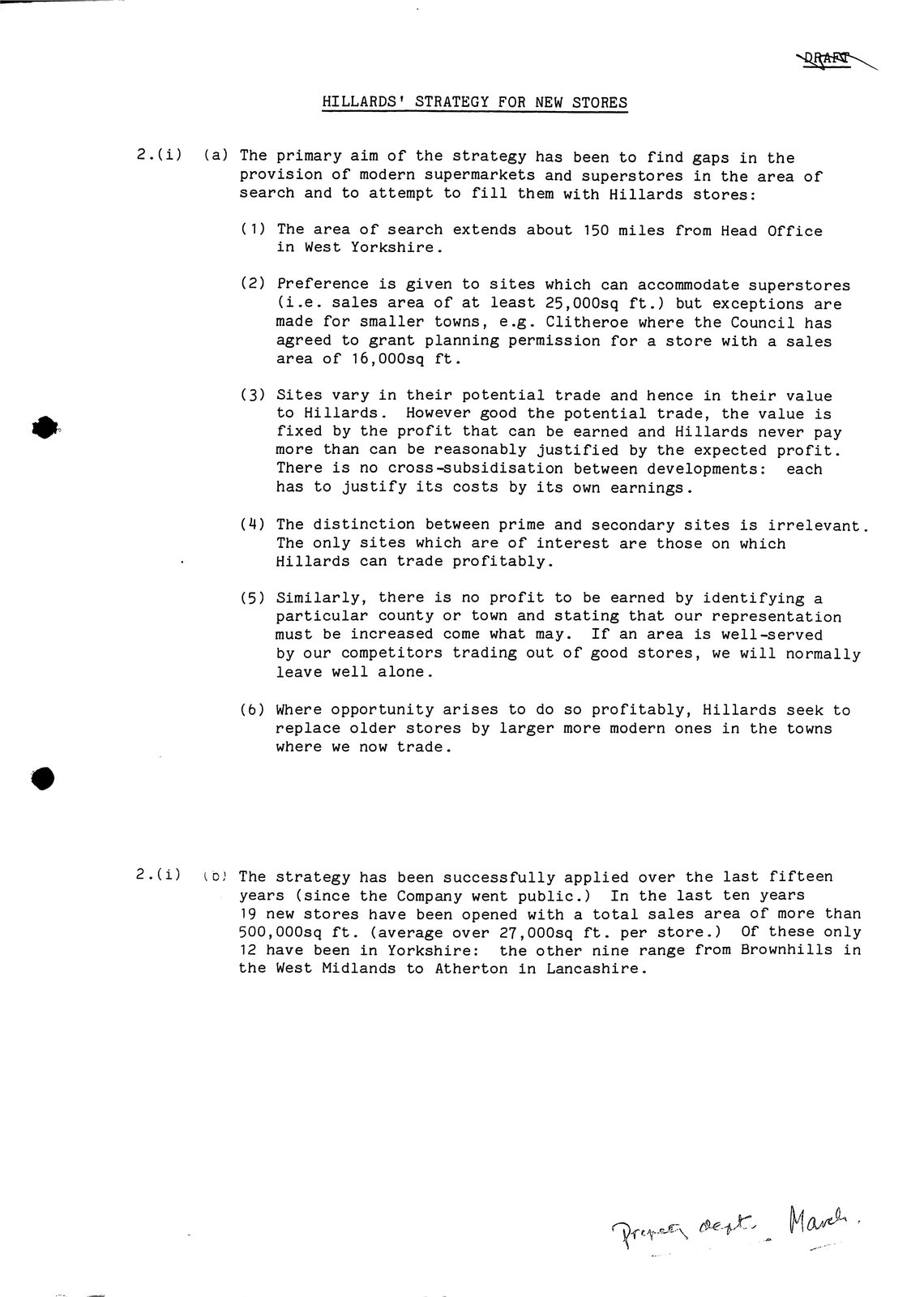
HILLARDS' STRATEGY FOR NEW STORES


2.(i) (a)  The  primary     aim  of  the    strategy   has   been to   find  gaps   in   the
           provision     of  modern     supermarkets     and    superstores  in  the   area  of
           search    and  to  attempt    to  fill   them   with   Hillards   stores:

            (1)  The  area   of   search    extends  about    150   miles from   Head  Office
                in   West     Yorkshire.

    (2) Preference is given to sites which can accommodate superstores
                 (i.e.   sales     area  of  at  least   25,000sq    ft.) but   exceptions    are
                made   for   smaller     towns,   e.g.   Clitheroe    where  the     Council has
                agreed    to  grant planning         permission   for a   store  with  a  sales
                area   of      16,000sq  ft.

           (3)  Sites    vary   in  their    potential    trade   and hence   in   their  value
    to Hillards. However good the potential trade, the value is
                 fixed by    the   profit    that can    be  earned   and Hillards     never  pay
                more  than     can  be   reasonably    justified    by  the  expected profit.
                There  is    no  cross-subsidisation         between   developments:      each
                has   to  justify    its    costs by   its  own   earnings.

           (4)  The   distinction       between    prime  and secondary      sites  is irrelevant.
    The only sites which are of interest are those on which
                Hillards     can   trade      profitably.

           (5)  Similarly,      there    is  no  profit   to be   earned  by  identifying     a
                particular      county   or  town    and  stating    that our   representation
    must be increased come what may. If an area is well-served
                by   our     competitors    trading   out   of good   stores,   we  will  normally
                leave    well   alone.

           (6)  Where    opportunity     arises   to   do   so profitably,    Hillards    seek  to
                replace     older   stores   by    larger  more   modern  ones   in  the  towns
                where    we  now   trade.


2.(i) (0;  The    strategy   has  been   successfully        applied  over the  last   fifteen
           years    (since   the  Company    went public.)        In  the last  ten    years
           19 new stores      have  been     opened with  a total     sales  area    of more  than
           500,000sq     ft. (average    over    27,000sq   ft.   per store.)      Of  these  only
           12  have   been   in  Yorkshire:      the  other     nine  range  from  Brownhills   in
           the  West  Midlands      to   Atherton   in   Lancashire.


                                                                                       7  Maw!
HILLARDS' STRATEGY FOR NEW STORES 2.(i) (a) The primary aim of the strategy has been to find gaps in the provision of modern supermarkets and superstores in the area of search and to attempt to fill them with Hillards stores: (1) The area of search extends about150 miles from Head Office in West Yorkshire. (2)Preference is given to sites which can accommodate superstores (i.e. sales area of at least 25,000sq ft.) but exceptions are made for smaller towns, e.g. Clitheroe where the Council has agreed to grant planning permission for a store with a sales area of 16,000sq ft. (3)Sites vary in their potential trade and hence in their value to Hillards. However good the potential trade, the value is fixed by the profit that can be earned and Hillards never pay more than can be reasonably justified by the expected profit. There is no cross-subsidisation between developments: each has to justify its costs by its own earnings. (4) The distinction between prime and secondary sites is irrelevant. The only sites which are of interest are those on which Hillards can trade profitably. (5)Similarly, there is no profit to be earned by identifying a particular county or town and stating that our representation must be increased come what may. If an area is well-served by our competitors trading out of good stores, we will normally leave well alone. (6)Where opportunity arises to do so profitably, Hillards seek to replace older stores by larger more modern ones in the towns where we now trade. 2.(i) (0; The strategy has been successfully applied over the last fifteen years (since the Company went public.) In the last ten years 19 new stores have been opened with a total sales area of more than 500,000sq ft. (average over 27,000sq ft. per store.) Of these only 12 have been in Yorkshire: the other nine range from Brownhills in the West Midlands to Atherton in Lancashire. 7 Maw!
Read by machine, contrast corrected
HILLARDS' STRATEGY FOR NEW STORES


2.(i) (a)  The  primary     aim  of  the    strategy   has   been to   find  gaps   in   the
           provision     of  modern     supermarkets     and    superstores  in  the   area  of
           search    and  to  attempt    to  fill   them   with   Hillards   stores:

            (1)  The  area   of   search    extends  about    150   miles from   Head  Office
                in   West     Yorkshire.

    (2) Preference is given to sites which can accommodate superstores
                 (i.e.   sales     area  of  at  least   25,000sq    ft.) but   exceptions    are
                made   for   smaller     towns,   e.g.   Clitheroe    where  the     Council has
                agreed    to  grant planning         permission   for a   store  with  a  sales
                area   of      16,000sq  ft.

           (3)  Sites    vary   in  their    potential    trade   and hence   in   their  value
    to Hillards. However good the potential trade, the value is
                 fixed by    the   profit    that can    be  earned   and Hillards     never  pay
                more  than     can  be   reasonably    justified    by  the  expected profit.
                There  is    no  cross-subsidisation         between   developments:      each
                has   to  justify    its    costs by   its  own   earnings.

           (4)  The   distinction       between    prime  and secondary      sites  is irrelevant.
    The only sites which are of interest are those on which
                Hillards     can   trade      profitably.

           (5)  Similarly,      there    is  no  profit   to be   earned  by  identifying     a
                particular      county   or  town    and  stating    that our   representation
    must be increased come what may. If an area is well-served
                by   our     competitors    trading   out   of good   stores,   we  will  normally
                leave    well   alone.

           (6)  Where    opportunity     arises   to   do   so profitably,    Hillards    seek  to
                replace     older   stores   by    larger  more   modern  ones   in  the  towns
                where    we  now   trade.


2.(i) (0;  The    strategy   has  been   successfully        applied  over the  last   fifteen
           years    (since   the  Company    went public.)        In  the last  ten    years
           19 new stores      have  been     opened with  a total     sales  area    of more  than
           500,000sq     ft. (average    over    27,000sq   ft.   per store.)      Of  these  only
           12  have   been   in  Yorkshire:      the  other     nine  range  from  Brownhills   in
           the  West  Midlands      to   Atherton   in   Lancashire.


                                                                                       7  Maw!
HILLARDS' STRATEGY FOR NEW STORES 2.(i) (a) The primary aim of the strategy has been to find gaps in the provision of modern supermarkets and superstores in the area of search and to attempt to fill them with Hillards stores: (1) The area of search extends about150 miles from Head Office in West Yorkshire. (2)Preference is given to sites which can accommodate superstores (i.e. sales area of at least 25,000sq ft.) but exceptions are made for smaller towns, e.g. Clitheroe where the Council has agreed to grant planning permission for a store with a sales area of 16,000sq ft. (3)Sites vary in their potential trade and hence in their value to Hillards. However good the potential trade, the value is fixed by the profit that can be earned and Hillards never pay more than can be reasonably justified by the expected profit. There is no cross-subsidisation between developments: each has to justify its costs by its own earnings. (4) The distinction between prime and secondary sites is irrelevant. The only sites which are of interest are those on which Hillards can trade profitably. (5)Similarly, there is no profit to be earned by identifying a particular county or town and stating that our representation must be increased come what may. If an area is well-served by our competitors trading out of good stores, we will normally leave well alone. (6)Where opportunity arises to do so profitably, Hillards seek to replace older stores by larger more modern ones in the towns where we now trade. 2.(i) (0; The strategy has been successfully applied over the last fifteen years (since the Company went public.) In the last ten years 19 new stores have been opened with a total sales area of more than 500,000sq ft. (average over 27,000sq ft. per store.) Of these only 12 have been in Yorkshire: the other nine range from Brownhills in the West Midlands to Atherton in Lancashire. 7 Maw!